
PRACTICE LIBRARY / 01
A next move
you can explain.
The GRC Career Transition Guide connects the work you have done to the work you want to do. Choose a role, build your evidence inventory and prepare an application whose claims you can defend.
56 pages · 19 chapters · 16 companion files
Read the 8-page previewNo email required to read the free preview.
GRC Career Transition Guide
$49 USD. One-time purchase of the listed edition and companion files.
Buy GRC Career Transition GuideAfter successful payment, download your files and save your access key. Automated delivery email is not provided. Read the purchase and access terms.
START WITH YOUR OWN RECORD
Your experience is the starting point.
Operations, audit, IT support and procurement can involve useful adjacent work. The guide helps you distinguish that experience from direct security work, educational practice and gaps that still need attention.
It is written for US candidates considering GRC, IT audit and third-party risk roles. It includes fictional candidate examples and dated employer examples, with links and clear limits. It does not promise that a short learning plan replaces a role's requirements.
Begin with one target. A supervised evidence-support position and a role owning complex supplier assessments call for different evidence.
A WORKING PREPARATION FILE
Make each part support the next.
Understand the work.
Compare responsibilities, constraints and outputs. Learn enough about systems and frameworks to ask a specific question.
Keep the facts intact.
Build an experience inventory, examine annotated bullet rewrites and study a complete fictional resume with separately labeled educational work.
Put the file to use.
Complete a small evidence project, tailor an application, rehearse supported stories and review what the search actually tells you.
INSIDE THIS EDITION
From role choice to a reviewable plan.
Nineteen chapters connect foundational learning to concrete outputs, with four background clinics, a technical-reading lab and a spreadsheet reconciliation exercise. The six-week sequence is adjustable preparation guidance, with no promised hiring timeline.
- Choose the work before the titlePage 3
- Learn the system well enough to ask a useful questionPage 6
- Use frameworks to organize a questionPage 9
- Inventory the work you have actually donePage 11
- Write a resume whose claims you can defendPage 14
- Build one small project with a complete answerPage 18
- Turn a posting into an application briefPage 21
- Have useful conversations about the workPage 23
- Prepare answers from evidence and practicePage 25
- A six-week preparation sequencePage 28
- Diagnose a stalled search without inventing the causePage 31
- Keep a working preparation filePage 33
- Four routes into the workPage 35
- Read a technical packet without pretending to be its engineerPage 39
- Decide what to learn before buying another coursePage 42
- Build an application someone can followPage 45
- Practice the spreadsheet behind the status reportPage 48
- Evaluate the team as carefully as the job titlePage 51
- Plan the first month around useful workPage 54
READ BEFORE YOU CHOOSE
Read the opening lessons in full.
This 8-page excerpt comes directly from the 56-page edition. It includes the cover, full contents and complete chapters on choosing the work and understanding system foundations. Resume examples and the later project are outside this excerpt.
Preview page 1 of 8. Use Enlarge page for a closer view. When the page is focused, use left and right arrows to change pages.
Read the complete free sample as text (8 pages)
Text from the same public sample shown above. Use the page images or PDF for diagrams, equations and original layout.
Sample page 1
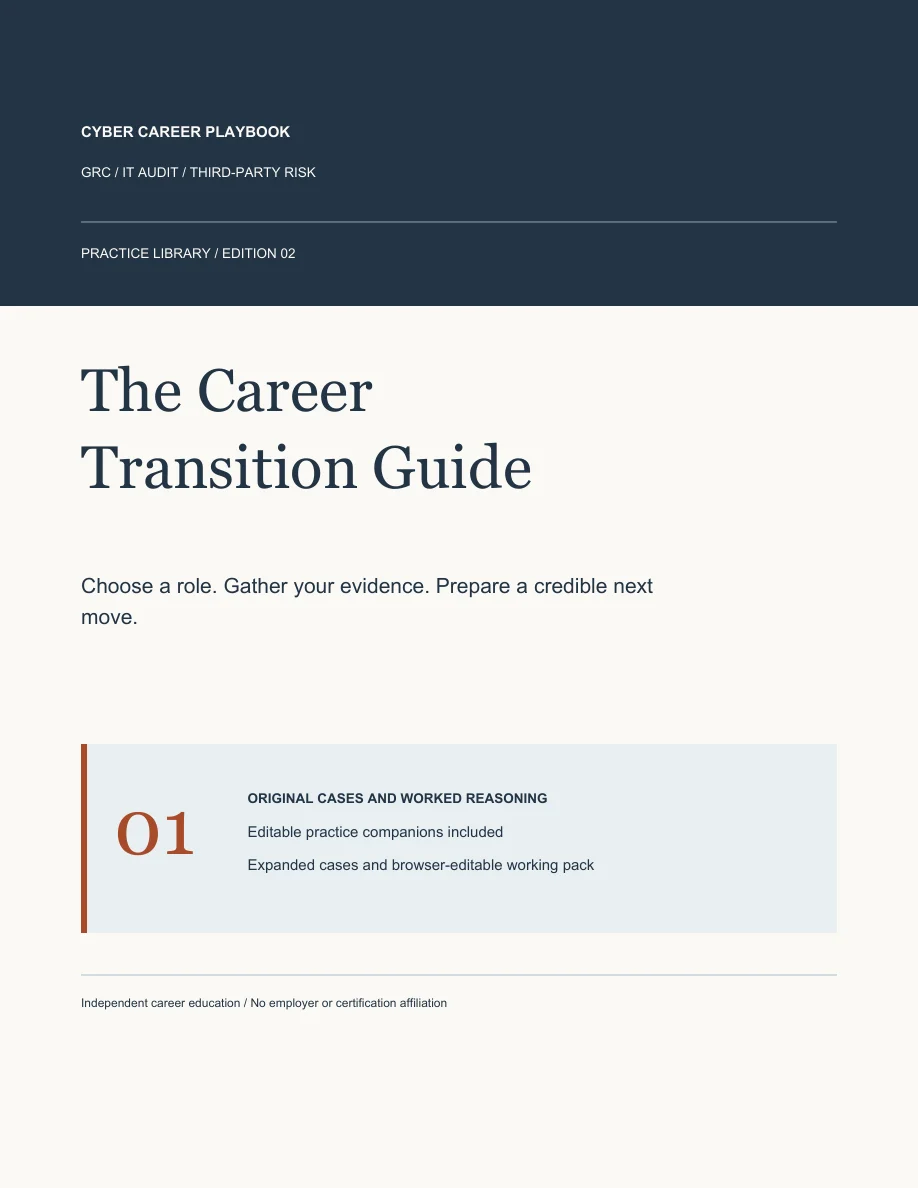
CYBER CAREER PLAYBOOK GRC / IT AUDIT / THIRD-PARTY RISK PRACTICE LIBRARY / EDITION 02 The Career Transition Guide Choose a role. Gather your evidence. Prepare a credible next move. 01 ORIGINAL CASES AND WORKED REASONING Editable practice companions included Expanded cases and browser-editable working pack Independent career education / No employer or certification affiliation
Sample page 2
CYBER CAREER PLAYBOOK PRACTICE LIBRARY / 01 Original educational material / Edition 02 2 CONTENTS Your route through the work 3 Choose the work before the title 6 Learn the system well enough to ask a useful question 9 Use frameworks to organize a question 11 Inventory the work you have actually done 14 Write a resume whose claims you can defend 18 Build one small project with a complete answer 21 Turn a posting into an application brief 23 Have useful conversations about the work 25 Prepare answers from evidence and practice 28 A six-week preparation sequence 31 Diagnose a stalled search without inventing the cause 33 Keep a working preparation file 35 Four routes into the work 39 Read a technical packet without pretending to be its engineer 42 Decide what to learn before buying another course 45 Build an application someone can follow 48 Practice the spreadsheet behind the status report 51 Evaluate the team as carefully as the job title 54 Plan the first month around useful work
Sample page 3
CYBER CAREER PLAYBOOK PRACTICE LIBRARY / 01 Original educational material / Edition 02 3 FIELD GUIDE / 01 Choose the work before the title Using this expanded edition Chapters 1-12 establish the preparation process. Chapters 13-19 add background-specific clinics, a technical-reading lab, application practice, spreadsheet reconciliation, team evaluation and a first-month plan. The companion archive includes START-HERE-working-pack.html: open it in a browser to edit the supplied tools, save a local working copy or print. Changes are not saved until you use the save control. Markdown and CSV originals remain available for text editors and spreadsheet software. Keep your own attempt separate from completed references. This guide is for people considering GRC, IT audit or third-party risk roles in the United States. You may be bringing experience from operations, procurement, compliance, accounting or IT. You may also be early in your career, with academic and project work as your main evidence. The route you choose should reflect what you can demonstrate and what a particular employer needs. The practical outcome is an application file: a role brief, an inventory of genuine experience, a targeted resume, a small educational project and a preparation schedule. You will also build a way to review your search when the first approach does not produce useful responses. The guide does not promise a job, a salary or a fixed time to hire. You do not need to buy every adjacent credential or learn every framework before beginning this work. Start by identifying the decisions and deliverables in the roles you are considering. That gives your learning a purpose and helps you avoid preparing for a title that means something different at the employer you want to join. Three role families, overlapping work A GRC role may involve maintaining risk information, coordinating evidence, supporting policy work and helping decision owners understand unresolved issues. IT audit work may emphasize defined objectives, procedures, documented results and reviewable workpapers. Third-party risk work may focus on a supplier's service, information access, evidence and the decisions made through its relationship with the organization. These are useful starting distinctions, not rigid boundaries. An employer may combine them in one position or divide them across several teams. A title alone will not tell you the level of technical depth, independence, authority or stakeholder contact expected. Read the verbs in a posting. “Coordinate evidence” differs from “design the assessment methodology.” “Support testing” differs from “lead the engagement.” “Maintain a register” differs from “approve the risk response.” Each verb points to a different contribution and often a different level of responsibility.
Sample page 4
CYBER CAREER PLAYBOOK PRACTICE LIBRARY / 01 Original educational material / Edition 02 4 Two employer examples The MBTA GRC Analyst posting inspected for this guide combines risk-register work, vendor assessments, audit evidence coordination and reporting. It also describes cross-functional work and responsibilities relevant to its transit environment. This is a specific employer example, not a universal entry-level checklist. Its breadth shows why a candidate should inspect the duties and constraints rather than assume every GRC role is mostly policy writing. MBTA posting. Sikich's Staff IT Auditor posting for federal audit describes testing, workpapers, findings and project deliverables. It also has context specific to federal engagements. Those duties suggest preparation that includes explaining a procedure and its documented result. They do not establish the interview format or requirements of every audit employer. Sikich posting. Both pages were inspected on September 25, 2026. Openings can change or close. Use these examples to learn a reading method, then check the employer's current posting before applying. This guide does not claim to measure the number of openings or your probability of being hired. Build a role brief Choose one current posting you would seriously consider. Record its employer, title, location, working arrangement, source and date checked. Then summarize the three most important tasks in your own words. Keep the full posting privately for reference if its terms permit, but avoid copying it wholesale into a public portfolio. For each task, identify a likely output: a risk-register entry, evidence request, workpaper, supplier review or management summary. This is your interpretation unless the posting names the output. Mark that distinction. It helps you prepare questions rather than treating your assumptions as employer facts. Next, record constraints separately from skills. Location, work authorization, travel, clearance, schedule and required credentials may affect whether the role is feasible. Do not assume a transferable skill compensates for an explicit eligibility condition. Where a condition is unclear, ask through an appropriate recruiting channel rather than guessing. A fictional comparison Jamie is an operations coordinator who tracks document requests, follows up on missing approvals and prepares weekly status notes. Jamie has not conducted an IT audit or evaluated a supplier's security report. Three postings look interesting: an evidence coordinator, a staff IT auditor and a senior third-party risk lead. The evidence-coordination role has the closest immediate overlap with Jamie's documented work. The audit role may be worth investigating if its education and experience requirements fit and Jamie can develop the relevant foundations. The senior lead role may require judgment and ownership Jamie has not demonstrated. That does not make the role family inaccessible forever; it changes the present preparation and application decision. Jamie should not rename prior document tracking as “enterprise cybersecurity risk management.” A stronger application explains the actual tracking work and its relevance to evidence coordination, while the learning plan addresses the security and assessment gaps.
Sample page 5
CYBER CAREER PLAYBOOK PRACTICE LIBRARY / 01 Original educational material / Edition 02 5 Choose a primary direction and an adjacent option For an initial preparation cycle, choose one primary role family and one genuinely adjacent option. This is an editorial suggestion to keep your examples and learning focused, not a rule about how many jobs you may consider. Revisit the choice when you gather better evidence. A candidate with audit experience might prioritize IT audit or GRC roles involving controls and evidence. A procurement candidate might investigate supplier-risk coordination while learning the security questions specific to the service. An IT support candidate might examine access-governance or control-evidence work, using genuine operational examples. An early-career candidate may need to compare internships, graduate programs, junior analyst roles and adjacent operational work. Read the actual requirements. A job labeled “entry level” can still contain experience or eligibility conditions; a job without that label may offer supervised work suitable for your background. Record what would change your choice Your role brief should include one uncertainty that matters. Perhaps you do not know whether the team expects independent report review or supervised evidence collection. Perhaps the posting combines policy and technical testing, and you need to understand the balance. A focused question can resolve that uncertainty more efficiently than another generic course. At the end of this chapter, produce a one-page brief and a short decision: pursue now, investigate further, or prepare toward later. State the reason in terms of duties, evidence and constraints. Avoid a numerical “fit score” that disguises subjective judgment as a hiring prediction. The rest of the guide works from that brief. If you change your target, update the brief and revisit the relevant resume and practice choices. A career plan should respond to evidence about the work and your preparation.
Sample page 6
CYBER CAREER PLAYBOOK PRACTICE LIBRARY / 01 Original educational material / Edition 02 6 FIELD GUIDE / 02 Learn the system well enough to ask a useful question GRC and audit work can require technical understanding even when the role does not involve writing production code. You need enough context to understand what a record describes, which boundary it covers and why a proposed action matters. This chapter provides a starting vocabulary through a fictional service, rather than a catalog of tools to memorize. Imagine a small company using a hosted document service. Employees sign in, upload files and assign colleagues to workspaces. Administrators can change permissions. A connector can read files from another system. The company depends on the service to complete a weekly workflow. Every detail here is invented for teaching. Assets and boundaries An asset is something relevant to the organization that needs to be understood and managed in context. In this example, useful things to identify include the service, workspaces, information, accounts, integrations and the business process they support. A laptop list alone would not describe the whole arrangement. Begin with a boundary sentence: “This review concerns the pilot workspace and its connection to the document store.” Then ask what is outside that boundary. If you later examine a different workspace or an administrator account that spans several services, record the changed scope. An inventory supports questions about coverage, but its usefulness depends on how it was created and maintained. A spreadsheet labeled “all applications” may be incomplete or out of date. Ask who owns it, when it was updated and what it includes before relying on it as a complete population. Identity, authentication and authorization Identity concerns the account or entity represented. Authentication concerns establishing that an actor is who or what it claims to be. Authorization concerns what that actor is permitted to do. In a conversation, keep those questions separate even though one system may handle several of them. For the fictional document service, a person might successfully sign in but have no right to administer a workspace. Another account might be used by an automated extraction process rather than a human. An export limited to human accounts would not necessarily answer a question about every identity with access. Multi-factor authentication adds authentication factors; it does not by itself establish that permissions are appropriate. A record showing MFA enrollment answers a different question from a documented role decision. Likewise, a role-review worksheet does not prove that authentication is configured as intended.
Sample page 7
CYBER CAREER PLAYBOOK PRACTICE LIBRARY / 01 Original educational material / Edition 02 7 Permissions and access changes A permission describes an allowed action or access within a system's model. A role may group permissions, but the meaning of a role name depends on the service. “Editor” is not a universal technical definition. Ask what it permits in the actual environment. An access process may include requests, approvals, implementation and later review. Those events can have different timestamps and owners. A ticket marked complete does not always establish the exact moment the system changed. To understand the sequence, identify what each record actually represents. For practice, draw four boxes labeled request, decision, implementation and review. Under each, write the record that would help establish the event. Then identify which links are assumptions. You do not need a live system to practice that distinction. Logs and evidence A log records events according to a system's configuration and behavior. A useful question is whether the event, time, actor and object are sufficient for the purpose at hand. A log entry may show an attempted action, a completed action or another event entirely; read its meaning before drawing a conclusion. Ask about time zones, retention, coverage and the source of an export when those details affect the analysis. If a record is missing, distinguish “no event occurred” from “the available record does not show the event.” The second statement may be all the evidence supports. In the fictional service, a “user disabled” event might help evaluate an offboarding sequence. It does not automatically establish that every separate application session ended or that no other account remained. Scope the conclusion to the mechanism and evidence examined. Change management A change can alter code, configuration, permissions or another part of the environment. A change record may document the request, assessment, approval, implementation and follow-up. The applicable process determines which steps are required and when. Do not assume every after-the-fact approval violates a rule. An organization may define an emergency path with different requirements. Conversely, calling something an emergency does not establish that the approved emergency process was followed. Read the criterion and compare the actual sequence. For an interview example, use an invented rule such as “the service owner must approve normal changes before implementation.” Then supply a request, approval and implementation time. Explain the result only against that invented rule. Do not present it as a universal standard or a real employer's process. Backups and recovery A backup is useful only in relation to what the organization needs to recover and under what conditions. A successful backup-job message is different from evidence that a particular restore procedure worked. Ask what was backed up, when, how it is protected and what recovery work has been exercised.
Sample page 8
CYBER CAREER PLAYBOOK PRACTICE LIBRARY / 01 Original educational material / Edition 02 8 For the fictional weekly workflow, the business may care about recovering before a cutoff. A restore that succeeds after the cutoff could still leave the business objective unmet. You would need the actual requirement and exercise scope to evaluate that question; this guide does not prescribe a recovery deadline. NIST's Small Business Quick-Start Guide highlights access management, MFA, software updates and backup testing as practical considerations. It is a useful starting resource, not a substitute for the requirements and service details in a real assignment. NIST SP 1300. Cloud responsibility Using a cloud provider does not remove every customer responsibility. The division depends on the selected service and configuration. AWS's official model, for example, distinguishes provider infrastructure responsibilities from customer responsibilities that vary by service, including data and access configuration. Consult the provider's service-specific material rather than applying one diagram universally. AWS shared responsibility model. In the fictional hosted service, ask who manages the physical infrastructure, the application, workspace permissions, data classification, integrations and user lifecycle. Do not assume the supplier's assurance material covers a customer-controlled configuration. A useful evidence request identifies which party owns the relevant activity. Your foundation worksheet Choose one simple fictional service and record six things: purpose, data, users and service accounts, permissions, dependencies, and responsible owners. Add one question about evidence for each. Keep the exercise synthetic; do not publish an employer's architecture or customer information. Then explain the service in ninety seconds to someone unfamiliar with it. If you use a term you cannot define, mark it for study. Your goal is enough understanding to ask and answer a useful question, with clear limits, rather than a performance of technical vocabulary.
EDITABLE COMPANIONS
Keep your own working file.
The package includes 16 Markdown and CSV source files plus a browser-editable working pack with local save and print controls. Templates, fictional references and review sheets serve different purposes; they are not separate projects.
- Role brief and experience inventory
- System-foundation and framework-reference worksheets
- Complete fictional resume example
- Cedar case packet, reference answer and revision exercise
- Educational project README template
- Application brief and submission tracker
- Interview story bank and conversation notes
- Six-week plan with a fictional planning example
- Search-review log and preparation checklist
- Expanded career clinics and an issue-tracker dataset
TRY A SMALL PROJECT FIRST
Three records.
One narrow conclusion.
The guide's Cedar exercise asks you to compare a fictional approval time with an activation record. You must keep that answer separate from whether an account list is complete. A hypothetical earlier approval then changes the reasoning.
For a free exercise now, open the Evidence Desk. For a longer connected project with registers and versioned memos, explore the Risk & Evidence Portfolio Kit. For repeated case practice, see the Interview Case Workbook.
Choose a starting point for your transition.
These preparation paths use the same guide and include distinct free exercises.
Audit-to-GRC preparation guide: experience, role fit and applicationsIT-operations-to-GRC guide: turn technical work into application evidenceBEFORE YOU CHOOSE
Questions about the guide.
Is this a certification course?
No. It is an application and preparation guide. It introduces bounded framework and system concepts without claiming certification, employer endorsement or professional qualification.
Can I use the fictional resume as my own?
Use its structure and reasoning to examine your own facts. The candidate, employers and project history are fictional. Do not present them as your experience.
Do I need a technical lab?
The exercises use supplied fictional records and editable documents. You do not need a live cloud account. The guide does not replace practical technical learning required by a particular role.
How do I access a purchase?
After successful payment, download the files from your order page and save the access key for recovery. Automated email is not provided. Read the purchase and access terms before ordering.
Before you decide
What would help you choose?
Start with the question that matters to you. You can use the free material without making a purchase.
Can I start with something free?
Try one relevant task first. If that resolves your immediate question, keep using the free resources. Inspect the book’s sample when you need more structured practice.
Build a free application briefHow would I put this to use?
A role brief, evidence inventory, targeted resume and application plan.
- Choose one relevant example or exercise from the sample. Write your own attempt before reading its explanation.
- Compare your approach with the explanation. Note a specific assumption, missing fact or step you would change.
- Revise your attempt, then revisit it in a later session without the explanation open.
Use this as a self-study routine, adjusting it to the material. Completing a session is not a certification or an assessment of hiring readiness.
One book, a bundle, or personal feedback?
Choose one book for a focused gap. Consider a bundle only if you will use its listed books; compare the exact contents and avoid paying twice for material you already own.
A PDF is self-directed preparation. Individual feedback on your own resume is a separate service with its own scope and availability.
Compare the resume serviceWhat should I check before paying?
Check the current price, included files, delivery instructions and refund terms before opening checkout.
Read the actual sample and file details on this page. If you need help with an order or access, contact support with your question rather than placing a second order.
Read purchase and refund termsAsk a product or access question