
PRACTICE LIBRARY / 03
Build the file.
Show how you reached the decision.
Build two fictional project files: a supplier decision and a recovery-readiness review. Connect source records to registers, calculations, findings and versioned memos. Then revise your work as new evidence arrives.
55 pages · 21 chapters · 24 companion files
Read the 8-page previewNo email required to read the free preview.
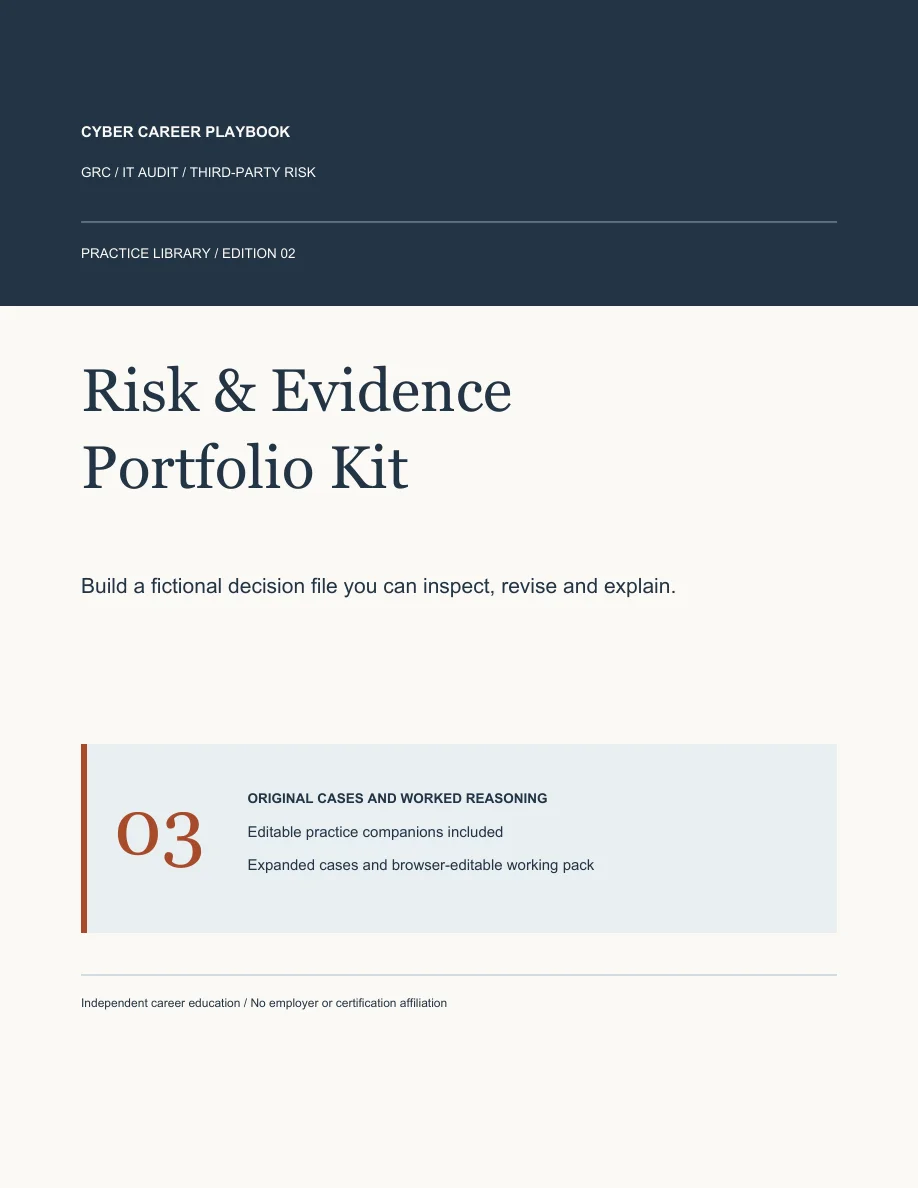
Risk & Evidence Portfolio Kit
$79 USD. One-time purchase of the listed edition and companion files.
Buy Risk & Evidence Portfolio KitAfter successful payment, download your files and save your access key. Automated delivery email is not provided. Read the purchase and access terms.
A PROJECT WITH A DECISION AT ITS CENTER
A synthetic-data pilot.
An incomplete record.
Six employees want to evaluate a document-processing supplier. You receive a business request, an approval procedure, account records and a dated configuration check. The question is whether the packet supports the proposed pilot decision.
You produce the analysis before reading the follow-up. Later records resolve account questions, introduce a request for customer-data use and reveal that activation preceded the required approval. The completed examples show how to preserve all three facts.
The company and records are fictional. You can practice with a text editor and spreadsheet application; no live cloud account, employer documents or technical lab is needed.
FROM SOURCE TO RECOMMENDATION
Every artifact has a purpose.
Know what the record supports.
Keep a human-only account export distinct from a complete population. Record source, scope, time and limitations in your evidence register.
Make the reasoning traceable.
Connect a scenario to its evidence, a procedure to its criterion, and a recommendation to the person authorized to decide.
Update the whole file.
Preserve the first memo, add the new records and update the affected conclusions. A later approval and an earlier sequence failure can both remain in the record.
INSIDE THIS EDITION
Two complete educational project files.
The guide develops two distinct projects through twenty-one chapters: a supplier decision file and a recovery-readiness review, followed by a fresh transfer exercise. It includes bounded framework mappings, worked examples and a review rubric. Open questions remain open when the packet does not supply an answer.
- Build a decision file, not a collection of templatesPage 3
- Give each record a jobPage 6
- Write risk scenarios that lead to an actionPage 9
- Map an outcome without claiming compliancePage 12
- Design a procedure someone else could repeatPage 14
- Make the supplier request fit the servicePage 17
- Record a deviation without inventing a storyPage 20
- Write a memo a decision owner can usePage 23
- Present the project as work you can explainPage 26
- Revise the file when the facts changePage 28
- Review the complete reference filePage 31
- Project two: a recovery-readiness decisionPage 34
- Build a dependency map that explains the resultPage 37
- Reconcile targets, observations and percentagesPage 39
- Turn the result into findings and actionsPage 41
- Write the initial management briefPage 43
- Evaluate a retest without erasing the first resultPage 45
- Present the complete recovery filePage 47
- Choose an extension that adds a new skillPage 49
- Review a file that looks finishedPage 51
- Transfer the method to a fresh packetPage 54
READ BEFORE YOU CHOOSE
Read the opening lessons in full.
This 8-page excerpt is extracted from the 55-page edition. It includes the cover, full contents, case orientation and complete evidence-register lesson with worked interpretations. Later chapters and the companion package are outside the sample.
Preview page 1 of 8. Use Enlarge page for a closer view. When the page is focused, use left and right arrows to change pages.
Read the complete free sample as text (8 pages)
Text from the same public sample shown above. Use the page images or PDF for diagrams, equations and original layout.
Sample page 1
CYBER CAREER PLAYBOOK GRC / IT AUDIT / THIRD-PARTY RISK PRACTICE LIBRARY / EDITION 02 Risk & Evidence Portfolio Kit Build a fictional decision file you can inspect, revise and explain. 03 ORIGINAL CASES AND WORKED REASONING Editable practice companions included Expanded cases and browser-editable working pack Independent career education / No employer or certification affiliation
Sample page 2
CYBER CAREER PLAYBOOK PRACTICE LIBRARY / 03 Original educational material / Edition 02 2 CONTENTS Your route through the work 3 Build a decision file, not a collection of templates 6 Give each record a job 9 Write risk scenarios that lead to an action 12 Map an outcome without claiming compliance 14 Design a procedure someone else could repeat 17 Make the supplier request fit the service 20 Record a deviation without inventing a story 23 Write a memo a decision owner can use 26 Present the project as work you can explain 28 Revise the file when the facts change 31 Review the complete reference file 34 Project two: a recovery-readiness decision 37 Build a dependency map that explains the result 39 Reconcile targets, observations and percentages 41 Turn the result into findings and actions 43 Write the initial management brief 45 Evaluate a retest without erasing the first result 47 Present the complete recovery file 49 Choose an extension that adds a new skill 51 Review a file that looks finished 54 Transfer the method to a fresh packet
Sample page 3
CYBER CAREER PLAYBOOK PRACTICE LIBRARY / 03 Original educational material / Edition 02 3 PROJECT FILE / 01 Build a decision file, not a collection of templates Using this expanded edition Chapters 1-11 develop the supplier decision file. Chapters 12-18 build a separate recovery-readiness project; chapters 19-21 add extensions, a review clinic and a fresh transfer exercise. The companion archive includes START-HERE-working-pack.html: open it in a browser to edit the supplied tools, save a local working copy or print. Changes are not saved until you use the save control. Markdown and CSV originals remain available for text editors and spreadsheet software. Keep your own attempt separate from completed references. This kit is for a candidate who wants to practice creating a small, coherent evidence file. You will work with a fictional services company, a document-processing supplier and a pilot decision. The output is a set of connected records: an evidence register, risk scenarios, a procedure worksheet, a finding, a decision memo and a short explanation of your work. The exercise is suitable for preparation across GRC, IT audit and third-party risk, with different emphasis for each role. It does not grant a credential or demonstrate that you have performed a real assessment. Every supplied company, person, event and record is fictional. Retain that label in any portfolio you share. You should understand basic terms such as account, role, permission, system configuration and supplier. You do not need a live cloud account, access to employer information or paid software. A text editor and spreadsheet application are enough. The practice value comes from the decisions you document and revise, rather than a complicated technical setup. The decision you are supporting Morrow Services wants to evaluate Finch Documents in a workspace called morrow-pilot-01. Six staff would process synthetic forms from September 21 through September 30. A possible later production connection is a different proposal. The operations director wants a recommendation by September 18, while procurement faces a commercial deadline on the same date. Your role is to prepare decision support. You are not the pilot approver. The fictional procedure identifies the operations director as the approver and assigns technical-boundary work to the technical owner. Keeping those responsibilities separate will matter when you write the recommendation and interpret the later records. This is a September case variant. If you have used the Interview Case Workbook, do not merge its June/July account list into this file. The company and supplier names are reused to make the setting familiar, but the population, period and records here are distinct. Give this project its own folder and case identifier.
Sample page 4
CYBER CAREER PLAYBOOK PRACTICE LIBRARY / 03 Original educational material / Edition 02 4 Read the packet in two stages The companion case-packet.md contains nine initial records and four follow-up records. Begin with PK-01 through PK-09. Write an initial recommendation before reading PK-10 through PK-13. If you have already seen the follow-up, you can still practice, but record that the attempt was not blind. The initial packet includes the business request, an approved fictional procedure, a technical-owner statement, a human-account export, a human-role review, a dated connector check, a service-account inventory, a supplier summary and a procurement note. These records do different jobs. A requirement does not establish execution; a review decision does not automatically approve the pilot; a commercial deadline does not create exception authority. The follow-up resolves some account questions, records a pilot decision, introduces a proposed scope change and supplies a historical activation event. The exercise deliberately contains both improvement and a newly supported deviation. A useful file should be able to record both without forcing every development into a single positive or negative story. What you will produce The evidence register records the source, scope, date and limits of each item. The risk register turns concerns into specific scenarios and identifies which assumptions matter. The assessment worksheet states a question, criterion, planned procedure and what the supplied packet supports. The finding explains a supported deviation without inventing consequences. The decision memo gives an owner a short, traceable recommendation. Your README explains that this is educational work, identifies your contribution and describes the file's limits. A revision log shows how new evidence changed the analysis. Together, these artifacts let another person follow your reasoning without attending a presentation or trusting a polished cover page. Do not fill every cell merely to make a spreadsheet appear complete. “Not established from the supplied packet” can be the accurate entry. The important next step is to explain what that uncertainty means for the decision and which request would reduce it. A practical folder structure Keep an untouched copy of the supplied packet in a source folder. Put your working register, worksheets and memo in a separate analysis folder. Use a version label or dated filename when your conclusion changes. Store a short README at the top level so someone can understand the project before opening a spreadsheet. For this exercise, filenames such as evidence-register-v1.csv, decision-memo-v1.md and decision-memo-v2.md are enough. A complex document-management system is unnecessary. The useful discipline is preserving the original record and making changes visible. If you prefer a single workbook, use separate tabs for the source inventory, risk scenarios, procedures and revision log. Keep the memo as a readable document rather than squeezing several paragraphs into one spreadsheet cell. A reviewer should be able to inspect the reasoning without learning your personal formatting conventions.
Sample page 5
CYBER CAREER PLAYBOOK PRACTICE LIBRARY / 03 Original educational material / Edition 02 5 The first ten minutes Read PK-01 and PK-02 first. Write the requested decision, intended service boundary and approval requirement in your own words. Then read PK-04, PK-05 and PK-07 together. Ask which account types are covered and which decisions remain open. Only then read the supplier summary and commercial note. This order is a teaching suggestion, not a mandatory assessment sequence. It helps prevent the commercial deadline or an impressive-looking supplier document from defining the review before you understand the request. In real work, the engagement plan and organizational process would determine the sequence. Your initial scope sentence might be: “This file supports the proposed synthetic-form pilot in morrow-pilot-01 for six staff during September 21-30. It does not approve customer-data processing or the later production connector.” That sentence will become a useful reference when a stakeholder asks a broader question. A quality bar you can inspect Before moving on, ask whether another reader could identify the decision, the period, the relevant records and your authority. If any of those are unclear, fix the case brief before creating more artifacts. An elaborate register built around an ambiguous decision will carry that ambiguity into every later document. The completed examples in this kit are reference answers, not the only acceptable wording. You can reach a different recommendation if it follows from the supplied facts and clearly stated assumptions. You cannot invent an earlier approval, a completed technical test or a legal conclusion because it makes the recommendation easier. YOUR WORKING NOTE Write the pilot decision and one activity outside its scope.
Sample page 6
CYBER CAREER PLAYBOOK PRACTICE LIBRARY / 03 Original educational material / Edition 02 6 PROJECT FILE / 02 Give each record a job An evidence register helps you find and interpret material. It should tell a reader what a record is, where it came from, which question it informs and what it cannot establish. A filename list alone does not do that work. Nor does a column marked “received” imply that the material answers the review question. Start with the initial nine records. The completed reference register covers this first packet; a separate blank is provided for your own attempt. Try filling the blank before comparing it with the reference. When you disagree with the reference, write why. The goal is to practice interpretation rather than reproduce wording. Record source and scope separately PK-04 is a human-account export for one workspace at a specified time. Its source is the supplied fictional export. Its scope explicitly excludes service accounts. Both details matter. If you record only “account list,” someone could later mistake it for the complete population required by the pilot procedure. PK-07 identifies two service accounts. It contributes additional scope information, but it is not itself a role-review decision. S-01 has an owner named in the inventory; its role decision is absent. S-02 lacks both a named owner and a role decision in the initial packet. Those are distinct gaps and should not be collapsed into “two failed accounts.” PK-05 accepts the roles for six human IDs matching PK-04. That supports the described review of those listed identities. It does not cover the service accounts and does not fulfill the separate requirement to approve pilot activation. A single document can be useful for one question and insufficient for another. A completed row, unpacked For PK-04, a useful “supports” entry is: “Six distinct listed human accounts and roles in the specified workspace at the export time.” A useful limitation is: “Parameter excludes service accounts; does not establish complete population across account types.” The next request asks for a complete workspace listing or an explained reconciliation appropriate to the procedure. Notice that the limitation follows directly from the record's stated parameter. You do not need to speculate about a hidden system defect. The question is whether the evidence covers the requirement. By writing the reason, you help a later reader understand why the request is necessary. For PK-06, the supported statement is different: the technical owner recorded a check showing no enabled connectors at 11:00 on September 16. The packet does not show that you performed the check or that nobody can change the configuration afterward. Your register should preserve the activity's source and point-in-time nature.
Sample page 7
CYBER CAREER PLAYBOOK PRACTICE LIBRARY / 03 Original educational material / Edition 02 7 Use status labels carefully This kit uses plain labels such as “received,” “follow-up open” and “resolved by later record.” They describe your working file. They are not formal assurance ratings or a substitute for an organization's assessment methodology. You can have a received document with an open question. You can also resolve one question while retaining another limitation. PK-06 may answer whether a dated check was recorded while leaving change authority unresolved. A single green cell would hide that distinction, so the reference register includes a next-request field. Avoid a confidence score unless you can explain its criteria and intended use. Assigning “92% confidence” to an owner statement creates precision the packet does not support. A short sentence about source, coverage and corroboration gives the reader more usable information. Keep time visible Document date, event date and date received may differ. PK-13 will later illustrate why that matters: a historical event can arrive after an initial recommendation. Recording only the day you received it could obscure the sequence you need to evaluate. For the initial register, retain each record's date and any stated event time. If a date is unavailable, use an explicit unknown rather than guessing. If the timing would change your conclusion, make the missing time a focused request. Do not overwrite an original register row when a follow-up arrives. Add the new record, then link the earlier open question to it. This preserves the basis of your first recommendation and shows how the file developed. The reference version is a teaching snapshot, not an instruction to erase history. Distinguish a request from work performed Suppose you write “reconcile all accounts.” That could mean you plan to ask the owner for a reconciliation, you performed one using supplied lists, or someone else supplied the result. Those are different activities. Add enough detail to make the status clear. In this exercise, you can compare IDs across the fictional records and document that comparison. You cannot claim to have queried Finch's systems, interviewed a real owner or independently confirmed the export. Use verbs that match the work: “compared the supplied IDs,” “read the recorded explanation” and “proposed a follow-up procedure.” Make the request answerable A weak request says, “Send all access evidence.” A stronger request says, “Provide the account population for morrow-pilot-01 covering human and service accounts, describe the inclusion criteria, and identify the owner and role decision for each assigned account.” It explains the scope and the missing decision.
Sample page 8
CYBER CAREER PLAYBOOK PRACTICE LIBRARY / 03 Original educational material / Edition 02 8 You might split that into two requests if different owners hold the information. Keep the decision date visible so the recipients understand why timing matters. In real work, follow the approved data-sharing and evidence-handling process. For this project, synthetic IDs are sufficient; do not collect actual employee records to make it look authentic. Your completed first pass Your register should contain nine initial rows, with IDs that match the packet. Check that PK-03 is identified as a statement, PK-06 as a supplied activity record, PK-04 as human-only and PK-05 as a role review rather than pilot approval. These distinctions are the foundation for the rest of the project. Then write three sentences: what the packet establishes, what the most consequential open question is, and what you would request next. A reasonable answer identifies the human-role decisions and dated connector check, then points to incomplete service-account decisions and the missing pilot approval. Another question may also matter, but explain its connection to this limited pilot rather than listing every possible supplier concern. Keep the reference register alongside your attempt. Mark the change that most improved your reasoning. That comparison can later form part of your portfolio presentation: an initial interpretation, a specific correction and a clearer decision record. YOUR WORKING NOTE Choose one record. State what it supports and one question it leaves open.
THE COMPANION PACKAGE
Blank files and completed references.
The 24 Markdown and CSV files include both case packets, reference answers and editable working templates. A browser-editable working pack adds local save and print controls. A file count includes both blank and completed versions; these are not 24 separate projects.
CSV files open in spreadsheet software. Markdown files open in a text editor. Keep your own attempt separate from the supplied reference answers.
- Thirteen supplier-case records and twelve recovery-case records
- Evidence and risk registers, blank and completed
- Two explained framework mappings and a blank mapping sheet
- Assessment worksheet and completed account-review example
- Finding template and completed approval-sequence finding
- Memo template and three completed memo versions
- Revision logs, follow-up reconciliation and assumptions register
- Portfolio README template
- Recovery calculations, action register, evidence register and two reference briefs
CHOOSE THE RIGHT PRACTICE
Written file or spoken answer?
Choose this kit when you want to build and present connected artifacts. The Interview Case Workbook focuses on answering case questions, handling follow-ups and practicing timed mock sessions.
You can start with the free Evidence Desk to try a shorter exercise. Read the guide to labeling an educational project before adding work to a public portfolio.
Choose a project starting point.
Each path uses this same kit and includes a separate free exercise to help you decide.
Evidence-register portfolio kit: source tracking and worked examplesRisk-register portfolio kit: scenarios, references and revisionsAudit-workpaper practice kit: procedures, results and evidence limitsSecurity decision-memo practice kit: evidence, options and revisionsBEFORE YOU START
What this project demonstrates.
Can I present this as client work?
No. Label it as an educational project using fictional records. Identify the analysis you personally completed and distinguish it from the supplied answer examples.
Does the kit establish framework compliance?
No. Two CSF 2.0 outcomes are used as partial educational mappings. The fictional pilot procedure supplies the case criteria; neither the project nor its mappings establish compliance.
Are the examples independently practitioner-reviewed?
No independent practitioner review is claimed. Selected primary guidance informs bounded background; source links and limitations are included in the manuscript.
How do I access a purchase?
After successful payment, download the files from your order page and save the access key for recovery. Automated email is not provided. Read the purchase and access terms before ordering.
Before you decide
What would help you choose?
Start with the question that matters to you. You can use the free material without making a purchase.
Can I start with something free?
Try one relevant task first. If that resolves your immediate question, keep using the free resources. Inspect the book’s sample when you need more structured practice.
Build a free project briefHow would I put this to use?
Supplier decision artifacts plus a recovery-readiness file with calculations and retest review.
- Choose one relevant example or exercise from the sample. Write your own attempt before reading its explanation.
- Compare your approach with the explanation. Note a specific assumption, missing fact or step you would change.
- Revise your attempt, then revisit it in a later session without the explanation open.
Use this as a self-study routine, adjusting it to the material. Completing a session is not a certification or an assessment of hiring readiness.
One book, a bundle, or personal feedback?
Choose one book for a focused gap. Consider a bundle only if you will use its listed books; compare the exact contents and avoid paying twice for material you already own.
A PDF is self-directed preparation. Individual feedback on your own resume is a separate service with its own scope and availability.
Compare the resume serviceWhat should I check before paying?
Check the current price, included files, delivery instructions and refund terms before opening checkout.
Read the actual sample and file details on this page. If you need help with an order or access, contact support with your question rather than placing a second order.
Read purchase and refund termsAsk a product or access question